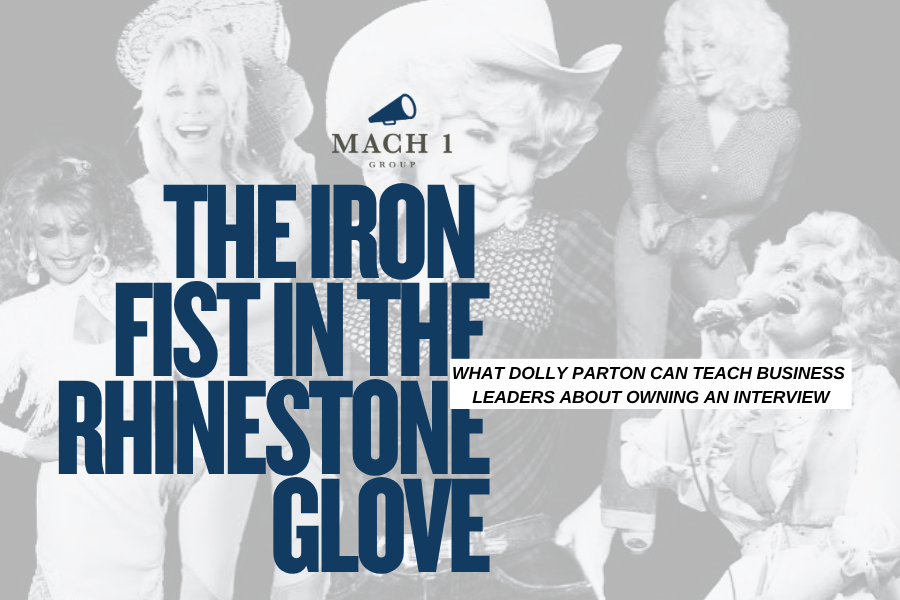
As the world remembers Dolly Parton, there is plenty to honor about the legacy she leaves behind. For those of us in the business of communications, that includes nearly six decades of masterful message discipline.
She mastered something every CEO, lobbyist and spokesperson eventually has to learn: the person asking the questions does not have to control the conversation.
Parton sat through thousands of interviews over the course of her career. Reporters asked about her body, her intelligence, her politics and just about everything else they thought might get a reaction. Some questions were fair. Others were condescending, provocative or plainly designed to put her on the defensive.
She rarely took the bait.
Instead, Parton answered the question she was willing to answer, usually with enough humor and authenticity that the audience hardly noticed she had taken control of the conversation.
That is not just Southern charm. It is message discipline.
Don’t fight the premise. Rewrite it.
One of the best examples came during Parton’s now-famous 1977 interview with Barbara Walters. When Walters asked whether she came from the kind of people she considered “hillbillies,” Parton didn’t bristle at the label. She reframed it, describing the people she grew up around as proud and intelligent, with “country class” and plenty of common sense.
It’s a lesson experienced spokespeople learn quickly: don’t argue on somebody else’s terms.
A reporter may characterize a project as controversial, a policy as costly or an industry as unpopular. Fighting the adjective can make you look defensive while reinforcing the reporter’s framing.
The better move is to replace the premise with your own.
Know where you aren’t going.
Parton’s other great strength was knowing where the boundaries were before an interview started. Politics was one of them, as reporters repeatedly tried to draw her into partisan fights. In a 2018 ABC News interview, David Wright pressed her about President Donald Trump. Parton declined to engage and explained why: “I’m not in politics. I’m an entertainer.”
The important part was not simply that she refused to answer. It was how she refused.
“No comment” can sound evasive. A clear explanation of why a subject is outside your lane can sound disciplined.
For a business leader, that might mean refusing to speculate about pending legislation. For an association executive, it might mean declining to speak for a member company. For a lobbyist, it might mean refusing to characterize a private conversation with a legislator. For a CEO, it might mean staying out of a partisan fight that has nothing to do with the company.
Understand how actions are perceived.
Parton’s discipline extended beyond interviews.
Two administrations offered her the Presidential Medal of Freedom. After personal circumstances prevented her from accepting the first offers, she later expressed concern that accepting the honor from another administration could be perceived as taking a political side.
That instinct should be familiar to anyone who works around the Capitol or runs a business with customers, employees and partners across the political spectrum.
Not every invitation needs to be accepted. Not every controversy requires your opinion. Not every question deserves the answer a reporter is asking for.
Charm works better when it is backed by discipline.
It is tempting to attribute Parton’s interview skill to personality. She was funny. She was likable. She could turn an uncomfortable question into a punchline.
But charm without preparation only gets you so far. That is the part worth copying.
Every executive or spokesperson eventually gets the question they hoped nobody would ask. It might come from a Capitol reporter, a local newspaper, an investor, an employee or somebody holding a microphone outside a hearing room. The objective is not to memorize enough talking points to survive it. It is to know your message well enough that a difficult question cannot knock you off it.
Dolly Parton spent a career demonstrating what that looks like.
Answer what you can. Redirect what you need to. And never hand somebody else control of your message.